
Buffalo County Criminal Court Cases
Buffalo County has two criminal court counters at 1512 Central Avenue in Kearney. County Court hears misdemeanors and handles the first stages of felony matters, including preliminary proceedings. District Court is the felony trial court. The shared address can mask that legal split. A case may start in County Court and move to District Court once a felony charge advances, so a complete search may require both levels.
The Buffalo County Attorney reviews reports from the Buffalo County Sheriff, Kearney Police Department, Nebraska State Patrol, Game and Parks, Shelton Police, and Ravenna Police before deciding whether and what to file. The Buffalo County court case begins with that filing, not with the arrest itself. The Clerk of District Court preserves felony pleadings, writs, process, summons returns, and proceedings. Buffalo County Court keeps its own misdemeanor and felony-preliminary files.
The Nebraska Judicial Branch directory for Buffalo County Court shows the official county-level court destination.
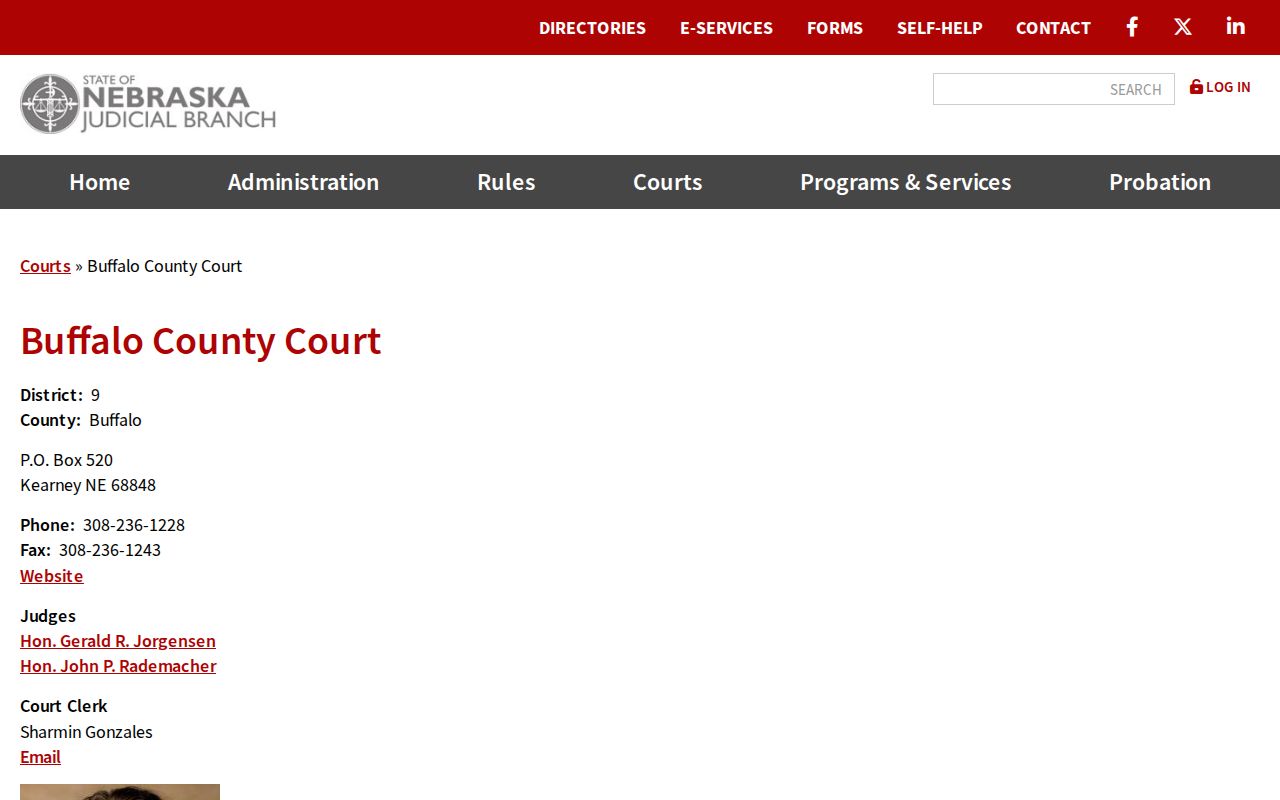
That directory helps confirm the clerk and court before a reader requests a copy or checks a hearing.
Two Buffalo County Criminal Clerks
Which Buffalo County counter should receive a request depends on the court shown in JUSTICE. Buffalo County Court uses PO Box 520 and can be reached at 308-236-1228. The Buffalo County Clerk of District Court also uses PO Box 520, but its direct number is 308-236-1246 and its email is districtcourt@buffalocounty.ne.gov. Giving the party's full name, case year, case type, and case number when known helps staff locate a specific public file.
Buffalo County Court
Misdemeanors and felony preliminary proceedings
1512 Central Ave, Kearney, NE 68848
308-236-1228
Buffalo County District Court
Felony trials and qualifying relief petitions
1512 Central Ave, Kearney, NE 68848
308-236-1246
The Buffalo County Clerk of District Court page describes the felony clerk's recordkeeping role and direct contact route.
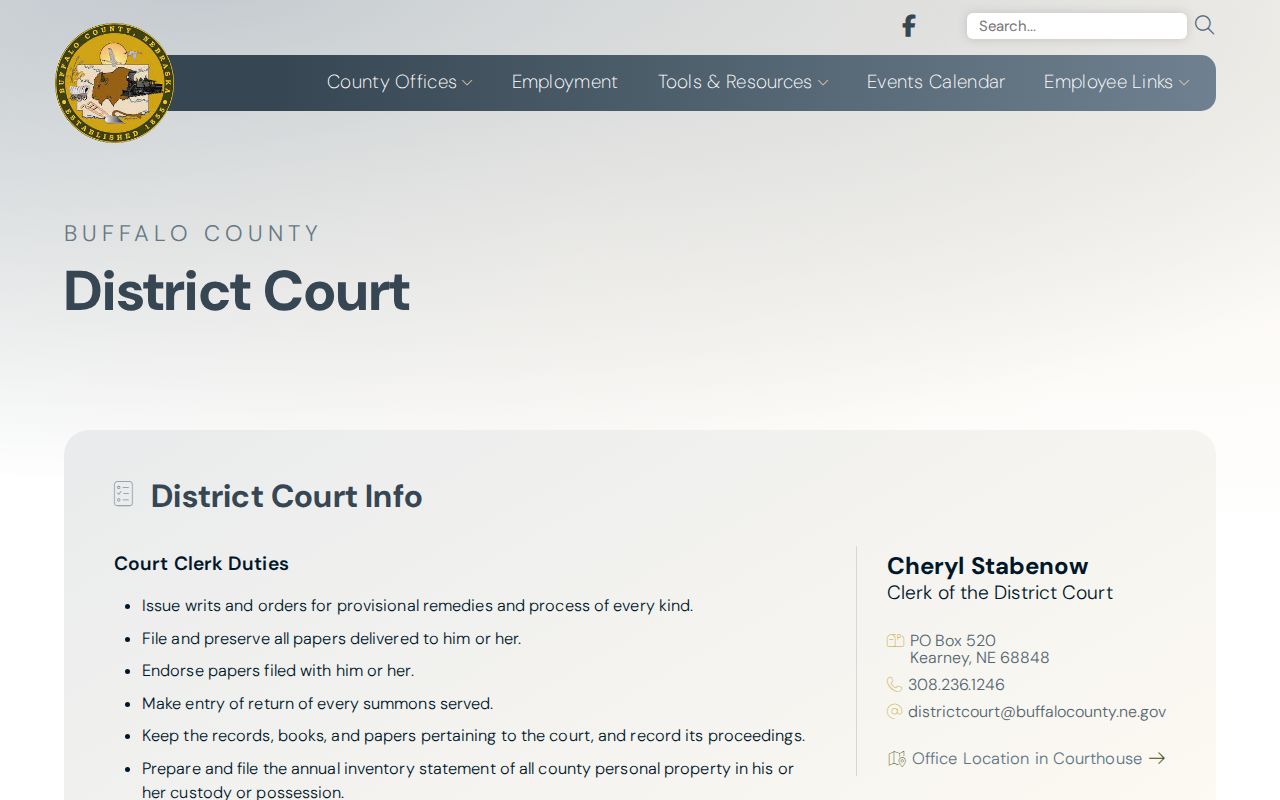
The office page is the right source for current contact details when a felony case file is not fully available online.
Searching Buffalo County Case Records
JUSTICE, Nebraska Trial Courts Case Search, is the main index for Buffalo County criminal court cases. A free courthouse terminal accepts a party name or case number. The online one-time search costs $17, returns no more than 30 records, and remains available for three days. Subscription service costs $100 per year for up to ten usernames, with $2 case-detail and specified searches. Pick the access route that fits one focused lookup rather than paying for filters that are not needed.
- Start with the free courthouse terminal or the JUSTICE one-time party-name search.
- Enter a complete party name, or use the case number when it is known.
- Narrow a broad list by county, court, case type, year, judge, or other available subscriber fields.
- Open the case detail and read the register of actions in date order.
- Ask the correct Buffalo County clerk for a plain or certified copy after identifying the case number.
| JUSTICE field | Access route | Use | Notes |
|---|---|---|---|
| Party name | One-time, subscriber, terminal | Find cases tied to a named party | One-time results stop at 30 records |
| Case number | Subscriber, terminal | Open a known case | Best match for a clerk copy request |
| Court and county | Subscriber filters | Limit results to Buffalo County | Distinguishes County and District Court |
| Case type or subtype | Subscriber filters | Narrow the legal category | Useful when a name returns many cases |
| Year, judge, attorney | Subscriber filters | Refine a broad result set | Use only facts known to be accurate |
JUSTICE Options for Buffalo Cases
The free terminal is often the best first choice for a Buffalo County reader who can visit the Justice Center. Court staff may help locate a specifically identified record, then provide plain or certified copies. They will not sign a certificate that says a broad name search found no record. Requests outside the Buffalo County court search policy may instead go to the State Court Administrator under the public-record process.
The Judicial Branch case-information page compares the one-time search, subscriber tools, and courthouse access.
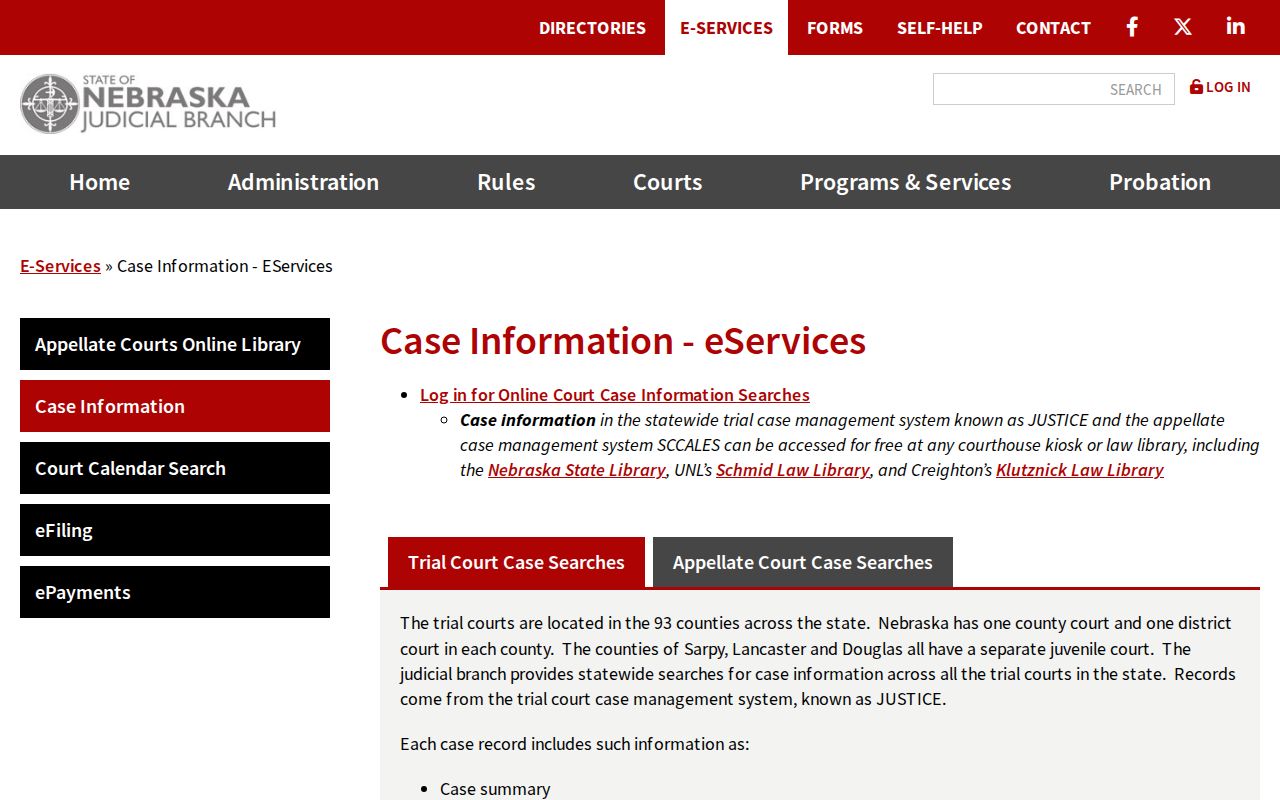
The service choices show why the paid web search is convenient but not the only way to inspect Buffalo County court records.
Most eligible images of nonconfidential documents have no extra online image fee. Yet an image may be absent even when a docket entry is public. In that case, note the filing date and title, then ask the clerk whether a public copy can be supplied. A sealed case or protected document will not become public merely because it is requested at the counter.
Inside a Buffalo County Case File
A Buffalo County case detail page brings together more than a charge label. JUSTICE may show the case summary, court and case identifier, parties, offense information, costs and judgments, register of actions, filed documents, hearings, orders, and many nonconfidential document images. The register of actions is the timeline. Read it from the first filing through the most recent order, then check each charge's own disposition.
| Case Number & Court | Identifies the file and whether County Court or District Court holds it. |
|---|---|
| Charging Document | The complaint or information states allegations filed by the prosecutor, not a finding of guilt. |
| Register of Actions | Lists filings, hearings, motions, orders, and other events in date order. |
| Hearing Dates | Shows scheduled or completed court events and helps place docket entries in sequence. |
| Disposition & Judgment | Records dismissal, acquittal, plea, trial outcome, conviction, or other final treatment by charge. |
| Sentence & Conditions | Shows the court-ordered result, which may include custody, probation, costs, or other terms. |
Financial lines also need care. “Assessed” is the amount ordered; “paid” records payment posted to the case. Those fields should not be treated as synonyms.
Reading Buffalo County Court Dockets
Plain terms prevent common Buffalo County case errors. A complaint or information is an accusation. An arraignment is the hearing where charges and rights are stated and a plea is entered. A register of actions is the dated list of what happened in court. A disposition is the outcome of a charge, while a sentence follows a conviction. “Dismissed” and “acquitted” do not mean convicted.
- Complaint
- A written accusation that begins a criminal matter.
- Information
- A prosecutor-filed charging paper often used instead of an indictment.
- Register of actions
- The court's chronological list of filings, hearings, and orders.
- Disposition
- The recorded outcome for a charge or case.
- Set aside
- Nebraska relief that nullifies a conviction for stated purposes but does not erase the case.
An initial offense can differ from the judgment because the prosecutor may amend a charge, the court may dismiss a count, or a plea may resolve the matter on different terms. The last reliable step is to read the final order and charge-level outcomes, not just the first row.
How a Criminal Case Moves
Buffalo County's documented path begins when the County Attorney reviews an agency report and files a charge. Misdemeanor cases remain in County Court. A felony generally moves through early County Court proceedings before the trial-level file reaches District Court. Motions, discovery, and negotiations may lead to a plea, trial, or dismissal. A conviction then leads to sentencing, and a later appeal or relief request creates more entries.
Case flow: Charges Filed › Arraignment › Pretrial › Plea or Trial › Disposition › Sentencing
This sequence is a reading aid, not a promise that every file has every step. A dismissal can end a case early. A plea may avoid trial. A felony file can also show related entries at both court levels.
Buffalo County Criminal Hearing Search
Nebraska's online court calendar offers another route when the goal is a hearing date rather than a full case file. It can be searched by date or a party's last name. Calendar information helps locate a session, but it does not replace the register of actions or final order. Schedules can change, so confirm a near-term appearance through the court record or clerk.
The Nebraska court calendar search displays the official calendar filters.
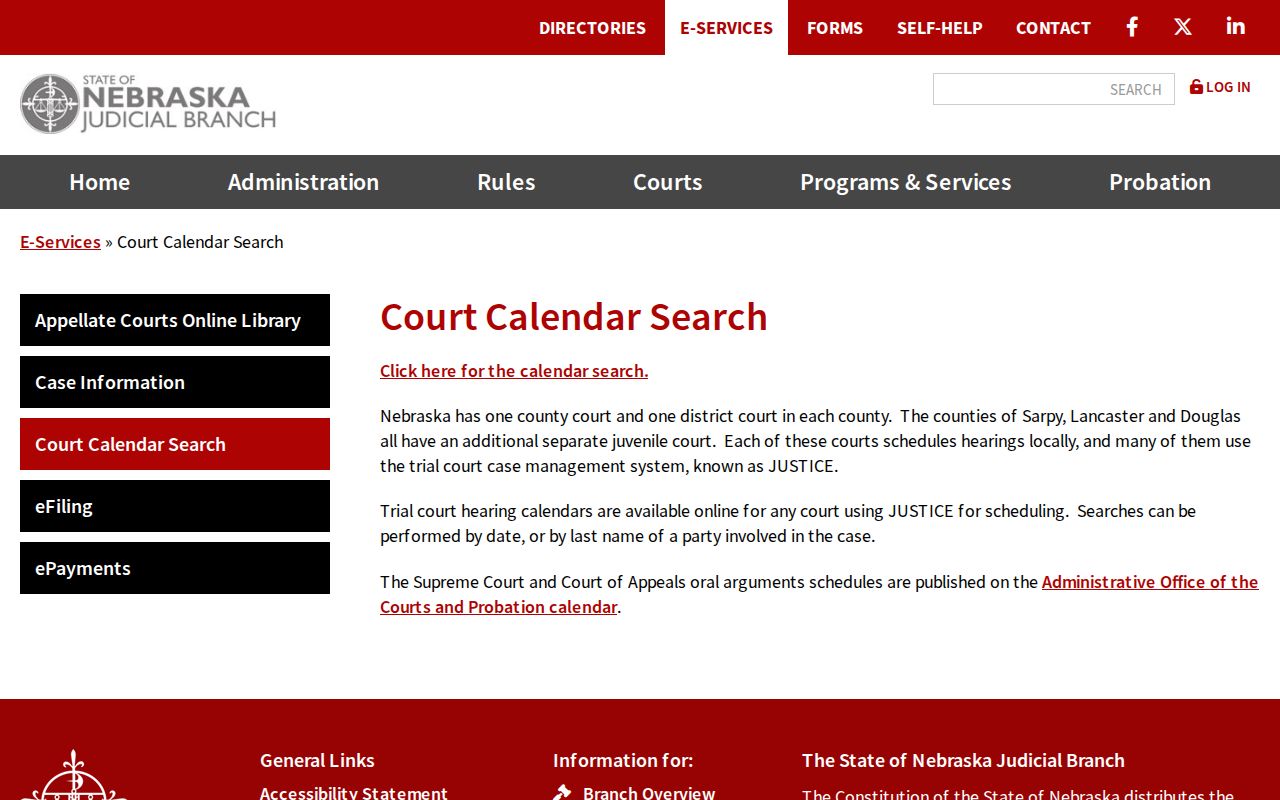
The calendar view is most useful as a companion to JUSTICE, where the Buffalo County case history and filed outcome remain.
Buffalo County Drug Court Trail
Central Nebraska Drug Court creates a distinct court-record path for an eligible case. The program spans Adams, Buffalo, Hall, and Phelps Counties across two judicial districts. Participation is voluntary and requires approval by the County Attorney and judge. An application is generally due within 30 days after District Court arraignment. Violent, serious-injury, firearm, and other excluded cases or histories do not qualify.
For an approved participant, at least 18 months of treatment, testing, supervision, regular court appearances, and judicial review can end with dismissal of pending felony charges. The docket may therefore show an initial charge, program steps, and a later dismissal rather than a routine plea or trial path. That is one reason the final register entries matter.
The Buffalo County Attorney's Drug Court page explains this local problem-solving route.
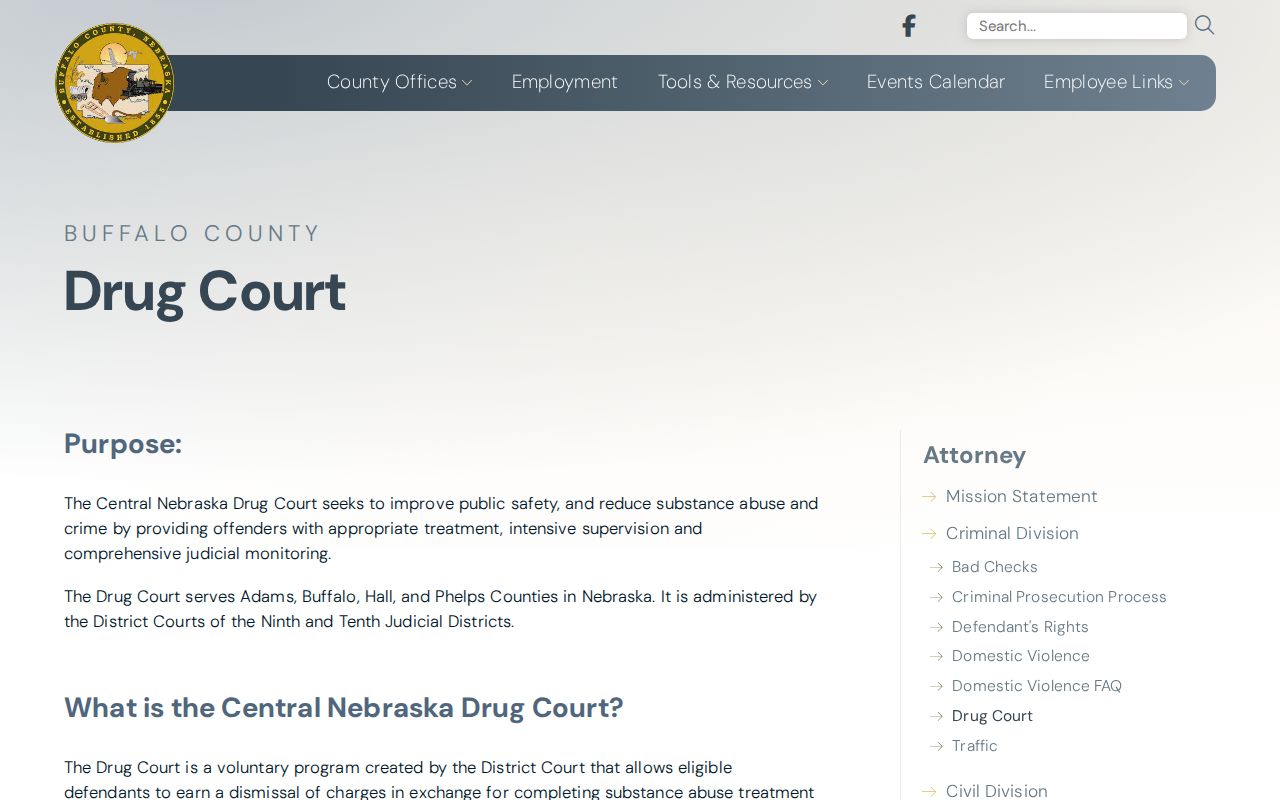
The program page supplies local context for docket entries that may not make sense when read as a standard prosecution.
Case Record Access & Restrictions
Nebraska court records are generally accessed through JUSTICE, the courthouse terminal, or the clerk that keeps the file. The Nebraska Public Records Act also sets inspection, response, cost, estimate, and deposit rules. It does not open every line. Juvenile cases, sealed matters, protected victim or minor data, Social Security numbers, and confidential material may be withheld or redacted. Public portions should remain available when protected details can be separated.
When a Buffalo County criminal case does not appear online, first confirm the spelling, court, year, and case number. Then contact County Court for a misdemeanor or felony preliminary file, or District Court for a felony trial file. A Nebraska set-aside does not erase the docket. Sealing and the narrow error-expungement route are different forms of relief with different rules.
Access rule: A missing web result is not proof that no case exists. Confirm the correct court and ask its clerk about public copies.
Arrest details and jail custody are separate records. When the question begins before charges were filed, the county's arrest lookup routes explain P2C, agency reports, and booking status.