
Checking Criminal History in Gibbon
A Gibbon records check works best when the search follows the record instead of a broad name query. Contract policing means the Buffalo County Sheriff creates or holds the law-enforcement side, while the shared Kearney Police Records Unit processes reports for the sheriff. Buffalo County courts keep filed cases. The Nebraska State Patrol holds the statewide fingerprint-based Record of Arrest and Prosecution, commonly called a RAP.
Use this order to keep Gibbon criminal records from being mixed together:
- Look in the official P2C system for a public incident report, wanted entry, or recent Buffalo County booking tied to Gibbon.
- For an existing Gibbon police or arrest report, call the shared Records Unit at 308-233-5250 and provide the incident number when known.
- Search Buffalo County Court or District Court through JUSTICE if the prosecutor filed a charge. A free courthouse terminal is also available.
- Ask the Gibbon City Clerk for city administrative records, ordinances, agendas, or minutes, not sheriff reports or court files.
- Order a Nebraska State Patrol RAP when the need is a certified statewide Nebraska criminal history rather than one Gibbon event.
Each Gibbon result proves only what its custodian recorded. A Gibbon booking is not a conviction, and a city document is not a court disposition.
Sheriff Contract Shapes Gibbon Records
Gibbon's adopted comprehensive plan documents a contract with the Buffalo County Sheriff for police protection. That fact corrects a common search mistake. There is no independent Gibbon Police Department records unit to call, no local police request form, and no separate police database. The plan also identifies a Sheriff/Gibbon Police satellite office in the City Fire Hall at 17 Gilmore Street. The satellite shows a local law-enforcement presence, but central dispatch and records still run through Buffalo County channels.
For a Gibbon report in progress or facts that cannot be submitted online, call the Sheriff at 308-236-8555. For a copy of an existing Gibbon incident or arrest report, use the shared Records Unit at 2025 Avenue A in Kearney. That office handles records processing for both the Sheriff and Kearney Police. The distinction matters because a call to Gibbon City Hall reaches the city clerk, whose files concern Gibbon administration rather than the sheriff's investigative work.
City Hall contact information is shown on the official Gibbon staff page.
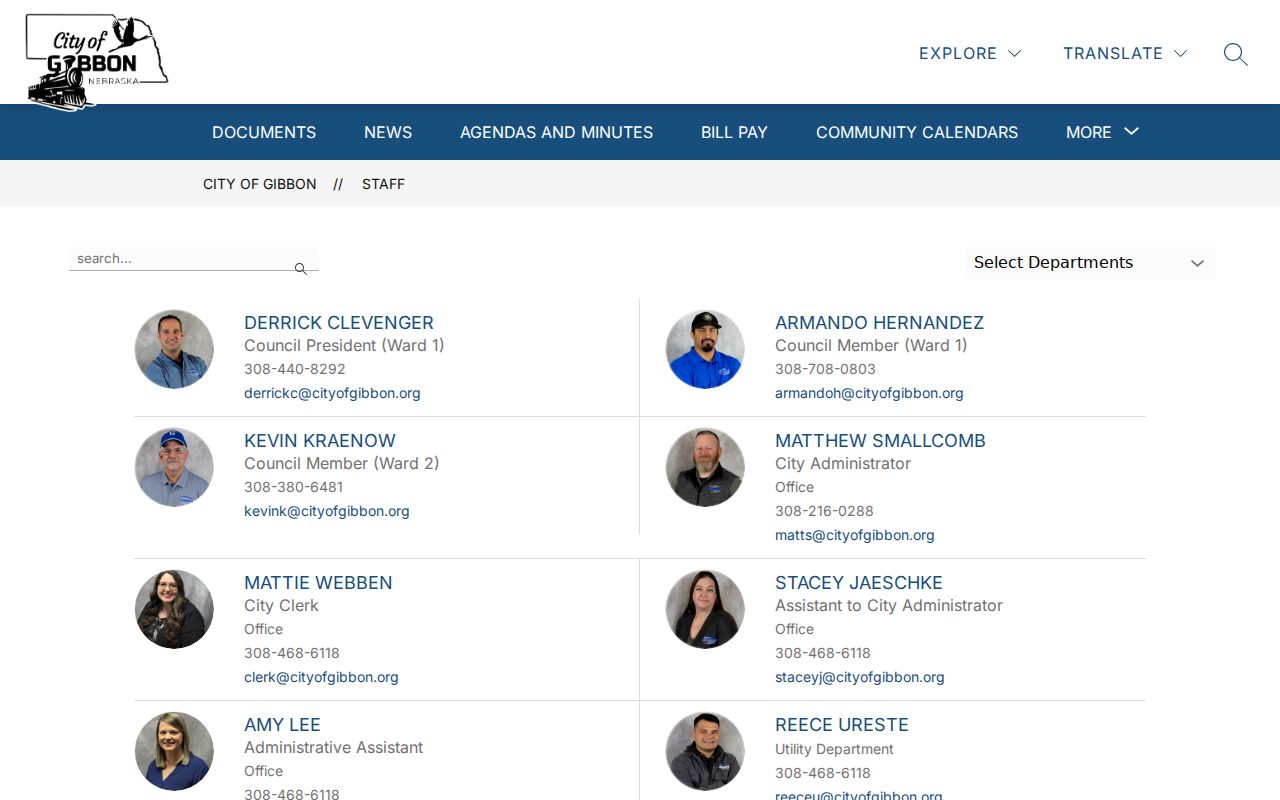
The image marks the correct city-level doorway for administrative records, while police reports stay with the county law-enforcement custodians.
Gibbon Police Department Records
The required heading describes the Gibbon police-record function, but Gibbon does not maintain a standalone police department. Buffalo County Sheriff deputies provide contracted Gibbon service. They create incident and arrest material for calls in Gibbon, and the joint Kearney Records Unit handles routine report copies. Gibbon's arrangement sits within a broader county system where the Sheriff provides communications and dispatch, while Kearney Police performs shared records and data processing.
Public P2C reports are free when posted. Records staff advise waiting at least 48 hours after an incident before seeking a routine accident or offense report. A copy costs $5 at the counter, $5 by fax, or $7 by mail with a self-addressed stamped envelope. A report may be withheld or redacted when it includes an active investigation, protected victim data, juvenile information, Social Security numbers, or other exempt content.
These Gibbon report channels do not provide a certified statewide criminal history. NSP CID supplies that RAP through its official request service.
Gibbon Records by Custodian
One Gibbon event can create several Gibbon records, and each office answers a different question. Starting with the type of document prevents a broad request from being sent to the wrong desk.
| Need | Official Gibbon Route | What It Provides |
|---|---|---|
| Incident or arrest report | BCSO/KPD shared Records or P2C | Agency report and public event details |
| City administrative record | Gibbon City Clerk | City documents, agendas, minutes, and administrative files |
| Ordinance text | Official Gibbon code library | The city rule in effect |
| Filed criminal case | Buffalo County Court, District Court, or JUSTICE | Charges, hearings, orders, and disposition |
| Recent custody | Buffalo County P2C inmate inquiry | Public booking and release status |
Gibbon City Hall is at 1029 Court Street, Gibbon, NE 68840. The Gibbon clerk can be reached at 308-468-6118 or clerk@cityofgibbon.org. Those contacts should not be used as substitutes for the Sheriff, Records Unit, or a court clerk.
The Gibbon municipal documents hub shows the city records that can be reached online.
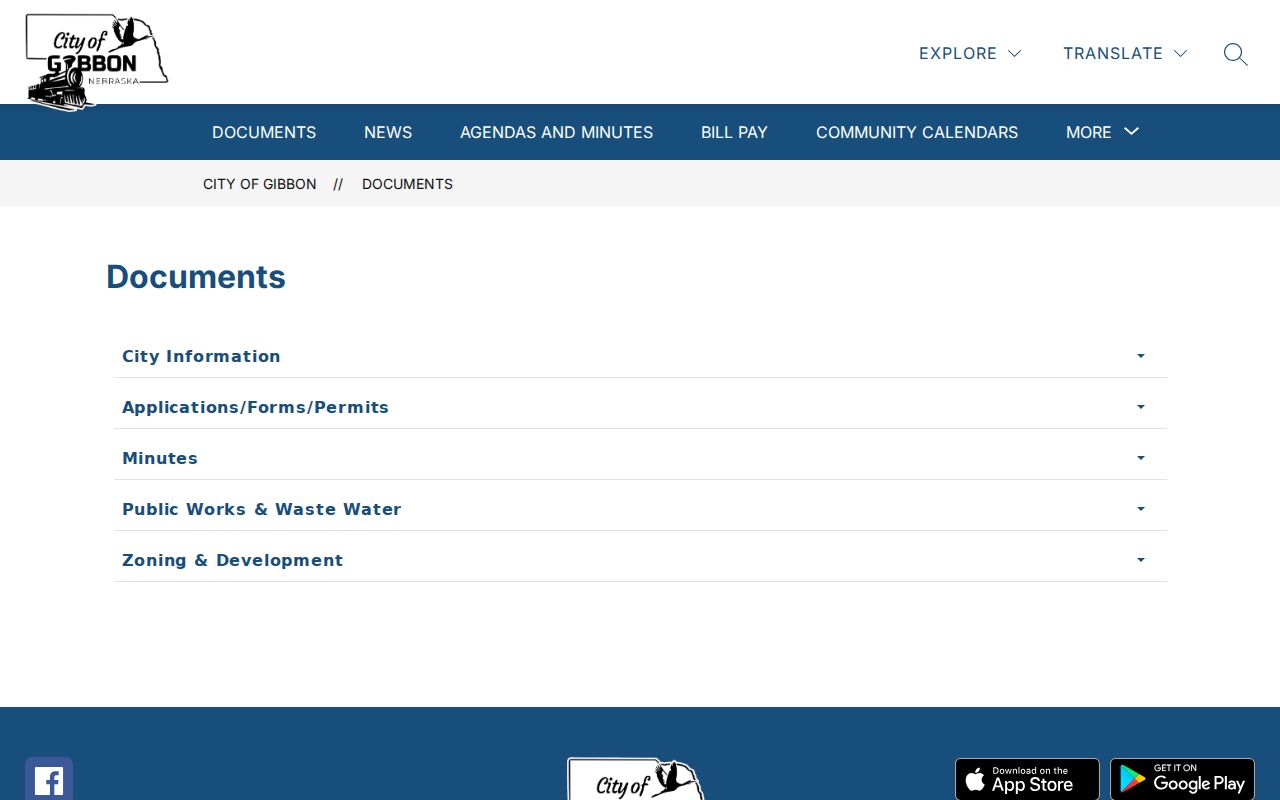
This municipal collection helps separate city governance records from criminal reports and case files held elsewhere.
Gibbon Arrests and Bookings
A person arrested in Gibbon is taken into the Buffalo County system rather than a city jail. The arresting deputy creates the incident or arrest documentation. If detention follows, staff at the Buffalo County Detention Center create a separate booking record. Current and recent public custody details can appear in P2C Inmate Inquiry, including the agency for which the person is held and a release date when applicable.
Gibbon booking records can include an intake date, presented charges, bond status, custody status, and release or transfer facts. They reflect what was known at intake. The Buffalo County Attorney later reviews the Gibbon law-enforcement report and decides whether and what to charge. A filed Gibbon misdemeanor or felony preliminary matter then appears in County Court; a felony trial proceeds in District Court.
Readers needing the full county arrest workflow can use the Buffalo County Arrest Lookup. At Gibbon altitude, the key point is simple: use P2C for booking, shared Records for the report, and JUSTICE for the filed case.
Note: A Gibbon booking entry documents custody, not guilt or the final outcome of a charge.
P2C Rules for Gibbon Reports
P2C is the named online portal that serves Gibbon through the county law-enforcement system. It offers report search, inmate inquiry, wanted entries, current closed calls, a daily bulletin, and online incident reporting. The tools are related but not interchangeable. A closed call is a dispatch event. It does not prove that an arrest occurred. An inmate result documents custody. A report can carry an officer's narrative and public incident facts.
Online incident reporting expressly includes Gibbon, but only when the Gibbon matter falls within covered jurisdiction and is not in progress. The Gibbon event must involve no violence, no known suspect information, and no evidence that needs processing. If any condition fails, the proper route is a call to the Sheriff at 308-236-8555. Emergency or immediate threats belong with 911.
When a submitted Gibbon report does not appear online, allow the ordinary processing time and contact shared Records with the incident number. Older files, active investigations, and protected content may require a focused Nebraska Public Records Act request or may be lawfully withheld in whole or part.
Municipal Court Records in Gibbon
Gibbon has no separate municipal court. Nebraska places city ordinance violations in County Court, which also handles nearly all misdemeanor and traffic matters plus preliminary felony proceedings. The city code identifies the local rule, but any resulting prosecution is a Buffalo County Court record. Felony trials belong in District Court. Both court levels are based at the Justice Center in Kearney.
| Court Name | Buffalo County Court for ordinance, misdemeanor, traffic, and felony preliminary matters; District Court for felony trials |
|---|---|
| Case Types Heard | City ordinance violations, traffic cases, misdemeanors, and the proper felony stage |
| Case Lookup Channel | JUSTICE online, a free courthouse terminal, or the correct court clerk |
| What the Docket Shows | Case summary, parties, filed offenses, hearings, register of actions, orders, costs, documents, and disposition when public |
| Copies & Fees | Clerk copies follow court policy; the online one-time JUSTICE party search costs $17, while the courthouse terminal is free |
A Gibbon search should use the court level that matches the charge stage. Misspellings, sealed files, the wrong court type, or more than 30 matching online results can hide an expected Gibbon case.
Gibbon Ordinance Records and Cases
Gibbon links its ordinance code through American Legal's official library. The research capture shows the code current through Ordinance 708, passed October 20, 2025. That source answers what the city rule says. It does not reveal whether a named person was cited, whether a prosecutor filed a case, or how the court resolved it. Those questions require the County Court docket and case file.
The official Gibbon ordinance code provides the governing municipal text.
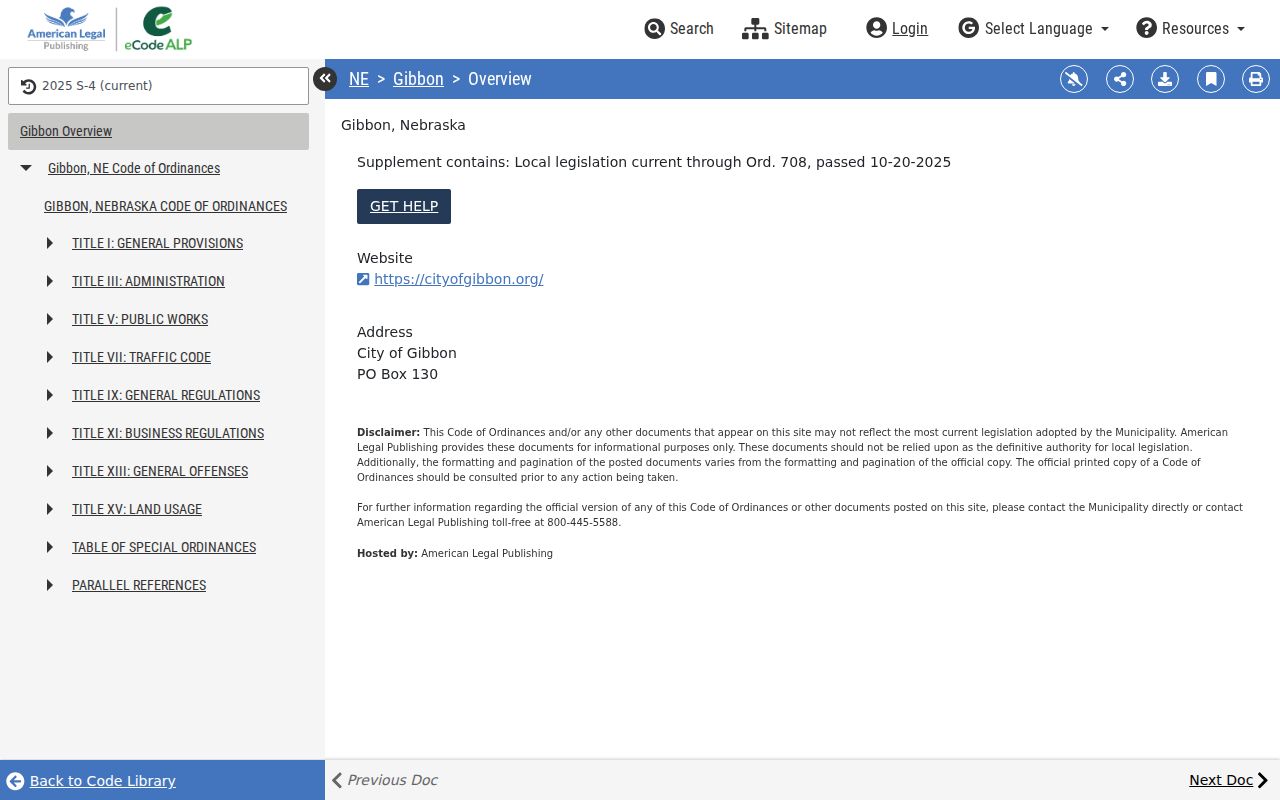
The Gibbon code image represents the rule layer, while JUSTICE and the County Court clerk provide the Gibbon prosecution and outcome layers.
- Complaint
- A written accusation that begins a criminal case.
- Register of actions
- The dated court list of filings, hearings, and orders.
- Disposition
- The result of a charge or case, such as dismissal or conviction.
- Booking
- Jail intake that records custody facts and presented charges.
Where Gibbon Records Go
A Gibbon incident can move through several custodians without becoming one combined file. The Sheriff records the event. The detention center creates custody data if a booking occurs. The Buffalo County Attorney reviews agency reports and decides on charges. The courts then create the litigation record. Fingerprint-linked arrests and reported outcomes may be sent to NSP CID for the statewide repository.
Record flow: Buffalo County Sheriff in Gibbon › Buffalo County Courts › Nebraska State Patrol CID
This Gibbon flow explains why a new arrest may appear in P2C before a Gibbon court case exists, and why an NSP RAP can differ from an agency report. The RAP covers Nebraska fingerprint-based arrest cycles and reported dispositions, not each Gibbon call, citation, or narrative. For self-review, compare the originating report, booking, court outcome, and RAP rather than treating one as a substitute for all.
Gibbon Criminal Data Boundaries
Crime totals require an exact label in Gibbon because the city contracts with the Sheriff. Buffalo County Sheriff counts cover a broader service area and cannot be presented as a Gibbon-only crime rate. The Nebraska Crime Commission query also warns that reporting completeness, population, travel, tourism, and other local conditions can affect comparisons.
A useful Gibbon data note should identify the reporting agency, geography, time period, and whether the number counts offenses, arrests, or rates. Those categories answer different Gibbon questions. Arrest totals do not prove convictions. County rates do not describe Gibbon. Missing agency months can also distort a trend.
The Nebraska Department of Economic Development's Gibbon profile supplies a separate view of current civic growth.

The state profile adds sound city context without turning county enforcement figures into unsupported Gibbon crime claims.
Gibbon Records and Courthouse History
Gibbon's city history adds a rare records lesson. The community was named for Union Brigadier General John Gibbon. About 139 families arrived on Good Friday, April 7, 1871, after a land agent promoted free land. Settlers backed a school, and Gibbon briefly became the Buffalo County seat. Its first courthouse was built in about 190 days.
The county seat moved to Kearney less than two years later. Gibbon was incorporated on January 14, 1885. That short courthouse period helps explain why present-day readers should not expect city court archives or a local criminal courthouse. Current ordinance matters, misdemeanors, and felony proceedings now follow Buffalo County's unified court route in Kearney.
Gibbon historical research should therefore distinguish old civic documents from current case access. Gibbon minutes and local records can preserve community history. Modern Gibbon criminal cases, however, belong with County Court, District Court, and JUSTICE.
Public Access Rules in Gibbon
The Nebraska Public Records Act applies to public records held by the city and county, including qualifying computer data. It does not make every line of a police or criminal record public. Custodians may redact protected victim and witness details, juvenile information, Social Security numbers, financial identifiers, and exempt investigative content. Sealed cases and certain non-conviction history are also restricted.
Send each Gibbon request to the office that holds the record. The Gibbon clerk handles city documents. Shared Records handles routine Gibbon Sheriff reports. Court clerks handle Gibbon case files. NSP handles the RAP. A focused request with an incident number, date range, and clear record description is easier to process than a request for every mention of a name.
Key Statutes:
Neb. Rev. Stat. §84-712 grants access and sets response, cost, estimate, and deposit rules.
Neb. Rev. Stat. §84-712.05 identifies records a custodian may withhold while leaving public portions subject to release.
Neb. Rev. Stat. §29-3523 limits public dissemination of specified non-conviction arrest history and governs narrow error-expungement relief.
Access does not settle meaning. Verify a charge against the final court disposition before drawing a conclusion from a Gibbon report or booking.